Project

Tulip Enzyme Solutions

Many chemical and pharma processes in the industry rely on inefficient or environmentally harmful methods. Biocatalysis offers a greener alternative, but natural enzymes and cofactors are expensive both to develop as well as to use in the processes. However, widespread adoption of biocatalysis is still limited by challenges related to toxicity, impurities and cost.

To overcome these challenges, our team has developed a synthetic cofactor system that can transform the fine chemical industry by improving existing processes and enabling the commercial use of cofactor-dependent enzymes for the production of a wide range of new products. This innovation provides a scalable and sustainable alternative for fine chemical production, reducing environmental impact while improving efficiency and affordability.

With our project Tulip Enzyme Solutions, we are driven to bring cutting edge biocatalysis to the forefront of the fine chemical industry, and aim to make great impact with our technology.

Project team

Allison Wolder and Caroline Paul

Project Number

BIOB25004

Year granted

2025

Status

Ongoing

Applicant

TU Delft

Funding

€ 199.976

Sector/Industry

Chemical, process, Mining industry, Agri- & Horticulture, Beauty, Wellbeing, Luxury & Fashion, Food & Beverages, Manufacturing & Production

SDG's

Responsible consumption and production (SDG 12)
Climate action (SDG 13)

Thematic Cluster

TC1: Industrial Biotechnology & Production

Level

Level 1
Molecuul

2025

Year granted

TU Delft

Applicant

€ 199.976

Project funded
Project story

Plant Beams: breaking through the plant barrier

The question that started Plant Beams For over ten years, David Fernández Rivas has worked on a technology that uses

Plant Beams: breaking through the plant barrier
Project story

SideroFORCE: Tricking bacteria to heal infection

We interviewed Wim Velema, projectleader of Biotech Booster project SideroFORCE, which joined our program in 2025. At sixteen, Wim liked

SideroFORCE: Tricking bacteria to heal infection
IBB

Behind the Bootcamp: Meet the IBB26 Coaches

Building an industrial biotech venture takes more than a great scientific idea. It requires the ability to challenge assumptions, make

Behind the Bootcamp: Meet the IBB26 Coaches
Project story

From Luggage Tags to Better Food

From fragmented DNA to better food on our plates. We interviewed Biotech Booster project Haplotagging to learn more about their

From Luggage Tags to Better Food
Impact developer portrait

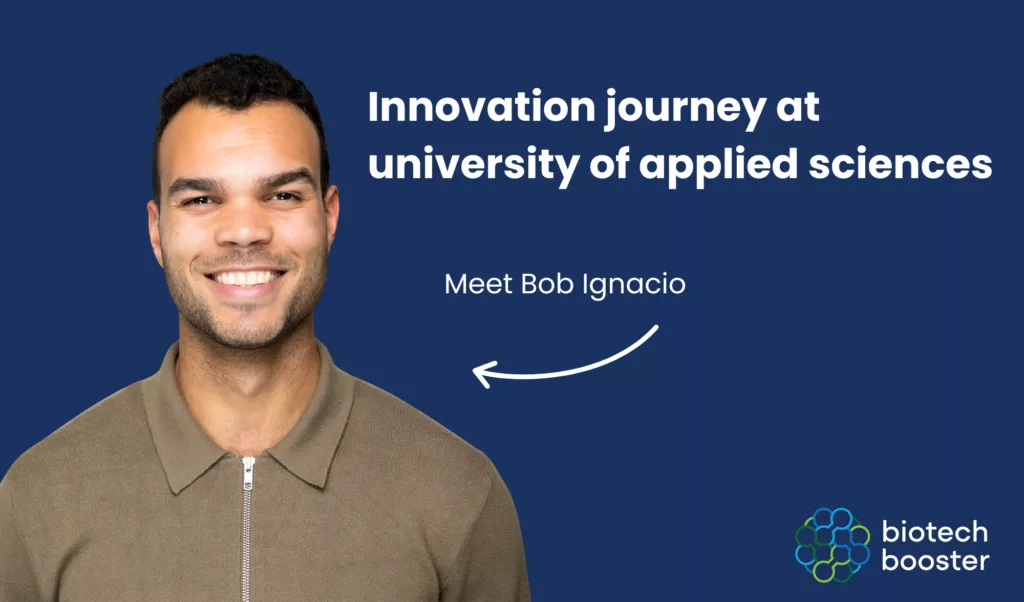
The Innovation Journey at the Universities of Applied Sciences

Impact Developers help researchers turn their ideas into innovations that impact society. They connect researchers with companies and other partners

The Innovation Journey at the Universities of Applied Sciences
Alumni Column

Alumni column: Patrick Dekker from iProtics

On both sides of the table. Some people know Biotech Booster from the outside. Others experience it from the inside,

Alumni column: Patrick Dekker from iProtics
Citaat

Biotech Booster helps us through funding and by providing us with a network to validate where we can make the best impact with our new analysis device.

Biotechnology netherlands

Carlos de Lannoy

Constellate

Citaat

What we look forward to most is leveraging the extraordinary network of Biotech Booster that we need to get foot in the market, get know-how, and understanding the competitive field which is necessary for setting up successful operations.

Biotechnology netherlands

Pim Schaasberg & Martin Pabst

ProteoT

Moleculen

Newsletter

Receive monthly updates about our community!

Subscribe to our newsletter