
On both sides of the table.
Some people know Biotech Booster from the outside. Others experience it from the inside, working their way through applications, meetings, questions and everything that comes with turning academic research into a company.
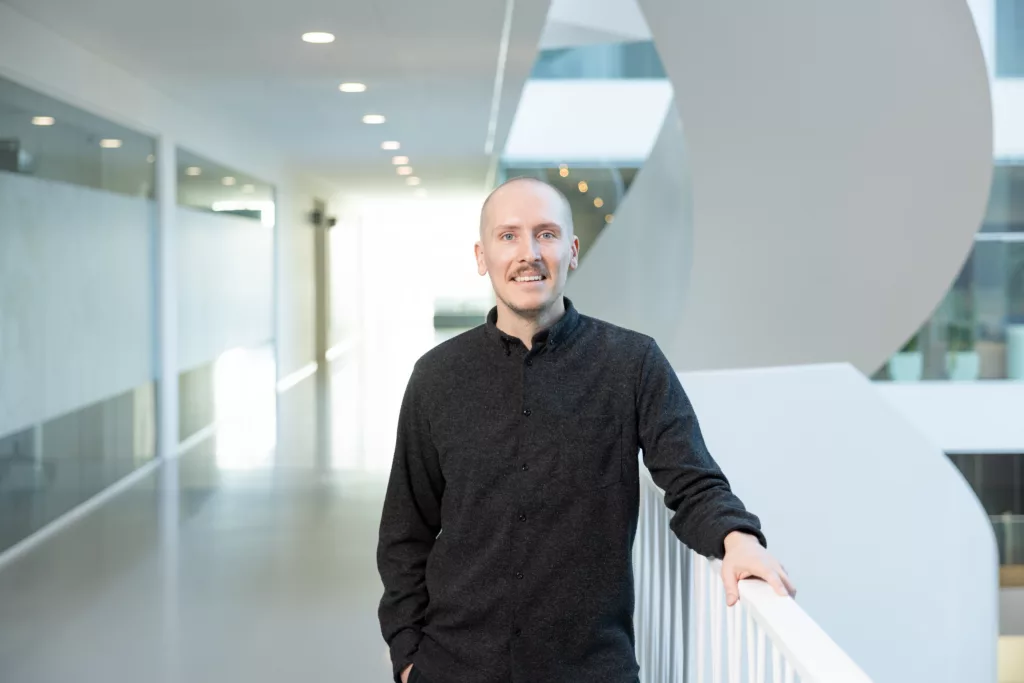
Patrick Dekker has done both.
Patrick is Chief Scientific Officer at iProtics, a company he co-founded with CEO Elmer Maurits. At the same time, he works as a Business Developer at Luris. As of May, he is also temporarily a Business Developer for Biotech Booster’s Thematic Cluster 5 (TC5) which focusses on vaccines, small molecules, and discovery & development platforms.
It may seem like very different jobs, but in Patrick’s case, they are closely connected. He has experienced the journey from university research to startup firsthand, and now he helps other researchers navigate that same journey.
From chemistry to entrepreneurship
Patrick trained as a biopharmaceutical scientist and later completed a master’s in chemistry. His journey into entrepreneurship did not start with a business plan, though. It started with a research question.
Patrick began working with Elmer in 2018, first as a master’s student and later as a PhD researcher. Their work focused on developing ways to block the proteasome, a large multi-complex protein inside our cells that breaks down other proteins.
The proteasome is already an important target in cancer treatment. Some blood cancers, such as multiple myeloma, can be treated by blocking the proteasome. The problem is that current treatments affect not only proteasomes in cancer cells. They can also affect healthy cells, causing serious side effects such as nerve damage that leads to numbness or tingling in the hands and feet, and heart problems, including abnormal heart rhythms.
So the question became: could you specifically block the proteasome in cancer cells without affecting the healthy cells?
That is where Patrick’s research came in. During his PhD, he worked on designing molecules that could selectively target one specific form of the proteasome. And then, somewhat unexpectedly, one of them did exactly what they had hoped.
Patrick still remembers the moment.
A student working with him tested the molecules and came across a result unlike anything they had seen before. At first, they assumed something had gone wrong, so they repeated the experiment, checked the results and repeated it again.
Eventually, Patrick went back to his professor, because they had found something super selective. He was flabbergasted, and the response was essentially: let’s go patent it.
When your research becomes a company
Until that point, the work had been academic research: a way to explore what was possible. But suddenly, there was something that might have a life beyond the laboratory.
Patrick and Elmer had already been working together for years. Elmer had originally been Patrick’s supervisor, and over time their relationship had evolved from student and teacher to colleagues and, eventually, friends.
So when the possibility of turning their research into a company came up, they decided to give it a shot.
“It’s quite a fun idea to move from doing something super academic and fundamental, and then take that baby kind of idea you’ve been working on for a very long time and see what’s possible in the entrepreneurial world.”
They started learning what that world actually looked like: what they could sell, who might need it, what a company needed, and how they could move their research toward something that could eventually become a drug.
In 2024, iProtics was officially founded. It was also the year the company joined Biotech Booster.
For Patrick, it was a rare opportunity to continue working on something he had started as a student. He describes it as a “once in a lifetime” opportunity, though he is also very aware of how difficult the road ahead is. Turning an interesting discovery into a drug that reaches patients is a long and uncertain process.
From project member to Business Developer
Fast forward two years, and Patrick has now completed his own Biotech Booster project journey. But instead of moving away from the program, he moved closer to it.
When Patrick mentioned during a Biotech Booster Project Day that he was leaving the university as a postdoc and wanted to positively influence Leiden university’s startup ecosystem, a conversation followed. That eventually led to his role at Luris.
And then another opportunity appeared.
With the TC5 Business Developer temporarily away, Patrick was asked to step in. There was one obvious reason why he was a particularly good fit: he had already done it himself.
The perfect bridge
Patrick is now helping scout projects at Leiden University and supporting researchers who are considering applying to Biotech Booster.
The difference is that he no longer has to explain the program from the outside. He knows what it feels like to sit on the other side of the application and has experienced what it is like to have an interesting piece of science but not yet know what the company around it should look like.
But he also knows that knowledge is only part of the problem. One of the biggest barriers between a promising academic discovery and a company is simply getting the money to take the next step.
The two are closely connected. Early-stage science is risky, and that makes it difficult to attract conventional investment. At the same time, researchers often navigate unfamiliar territory: which funding is available, what investors want, how to validate a market, and what needs to happen before an idea is ready for the next round.
That is where programs like Biotech Booster can make a difference. Funding gives a project the opportunity to develop, while the network and expertise around it can help projects answer the right questions and prepare for what comes next.
For Patrick, that is a big part of his role. Helping researchers understand what they need, connecting them to the right people and giving them the tools to move their science forward.
Still following the science
For now, Patrick’s two worlds continue to overlap.
At iProtics, the ambition remains to take their selective immunoproteasome inhibitors further and find out whether the original discovery can eventually become a better treatment for blood cancer.
There is still a long road between an interesting molecule in the lab and a drug for patients. There are experiments to run, money to raise and many questions that still need answers.
But that uncertainty is part of what keeps Patrick interested.
“I mean, when in my life will I get the chance to work on something like this that I originally also developed in my PhD?”
It is a rare position to be in: to help discover something, help build a company around it, and then use everything you learned along the way to help other researchers make their own leap from science to entrepreneurship.