
From fragmented DNA to better food on our plates. We interviewed Biotech Booster project Haplotagging to learn more about their technology and their journey through the Biotech Booster program.
The Netherlands is a small country with a very big appetite for food production. It is a global food superpower, competing with much larger countries in everything from seed development to crop production. But that position comes with challenges. Nitrogen restrictions, drought and changing climate conditions are putting pressure on the system.
For Frank Chan, that makes innovation necessary, and he admires how the Dutch go about it. He points to the depth here in the sciences and techniques behind modern breeding: cytology, phytopathology, molecular biology, doubled-haploid production. And to the nerve to push them further than most.
“They do magical things in the Netherlands, with a lot of audacity,” he says.
Frank knows a thing or two about crossing borders. He grew up in Hong Kong, “the place where cultures meet”, and went to France on an exchange when he was just 16. He has been travelling ever since, picking up languages along the way. Today he speaks six, and is working on a seventh.
What fascinates him is how meaning survives the move between places. A language works because its words keep an order; scramble them and the sense is gone.
For someone who collects languages, the genome is the irresistible case. “Reading the genome is like trying to understand a foreign language,” Frank says. “It’s the oldest book there is. And you have many different copies and dialects of it.”
“Our genetic blueprint should not work,” he adds. “It is a jumble of information. And yet molecules, just proteins and nucleic acids, somehow do it, all the time. That’s fascinating. I want to understand that.” That it works at all comes down to order. A genome that looks like a jumble still holds its meaning, for anyone who can read it. The trouble is that the usual way of reading DNA shreds that ordered text into a heap of loose words, throwing away which ones belonged together in the same sentence. Recovering the sentence is the problem haplotagging was built to solve.
Tag your luggage
So what does haplotagging actually do?
Imagine traveling to New Zealand with five suitcases. You check them in, they disappear behind a conveyor belt, and somewhere along the way millions of pieces of luggage are moving in every direction. You could simply hope you find the right bags when you arrive. Or you could tag them.
That is essentially what haplotagging does with DNA. Before the DNA is broken into millions of smaller pieces for sequencing, the team attaches a molecular barcode to it. Every piece that came from the same original strand of DNA carries the same tag. So when all those fragments have traveled through the sequencing process, the tags let the team work out which pieces belonged together in the first place. In the language of the genome, it recovers the sentences where ordinary sequencing leaves only scattered words.
That is the company, in Frank’s telling. “We’re the travel agents,” he says. “We tag everything going in, so that instead of the pieces scattering to the four winds, you get back the whole story.” Breeders send in samples and get back answers they can act on.
The technique itself is based on a clever bit of molecular repurposing. The team uses a mechanism derived from so-called “jumping genes”, which naturally move around genomes, to attach the tags. A biological trick that evolved for one purpose, put to work for another.
Why it matters
Recovering that lost context is the whole point, because today plant breeders work partly blind. Looking at a seed or a seedling, they can read which genetic variants are present. What they cannot read is how those variants are arranged together, which is what actually determines the plant. Two questions in particular are hard to answer, and both are expensive to get wrong: Is this seed lot pure? Every seed the intended variety, with no accidental off-types. A single stray cross can ruin a lot worth a fortune, and today the surest test is to grow it out and wait a whole season. Which seedling, out of thousands, carries exactly the right combination of traits? Find it now, and the breeder skips extra generations of breeding to discover it later.
Haplotagging answers both from the same data. It lets breeders see what they are actually holding, and find the plant they are looking for years earlier. Frank puts it this way: “With haplotagging, what we offer is not cheaper genotyping. What we are really delivering is in fact far more valuable: time.”
From potatoes to strawberries
The team has not been picky about what they put on the conveyor belt.
Over the past year they have run haplotagging on thousands of genomes, spanning sugar beet, potatoes, strawberries and tilapia fish, as well as samples from other organisms. The technique works across very different biology, and has already drawn interest from breeders, including HZPC, a major potato breeding company.
For Frank, the smaller companies are where this matters most. The giants can already afford deep genomics. A mid-sized breeder often cannot, even though climate and market pressures hit them just as hard, sometimes harder. Leveling that playing field is part of what the team set out to do.
“We have the flexibility to give a smaller breeder the kind of capability that used to belong only to the biggest players,” Frank says.
The next step is commercialization. The team is working towards a spin-out, with the aim of putting haplotagging within reach of more breeding programs over time.
A long road to the plate
But what could all this mean for the food we actually eat?
Frank has a simple dream: “I’d love for our work to end on your plate.”
A fairly large gap remains between a promising technology and a strawberry on your plate. Developing a new crop variety can take seven to ten years, or even longer. So while Haplotagging may be moving quickly, the food itself has a much longer journey ahead.
And that journey will not stop at the Dutch border. The seed industry is highly international, and Frank is already seeing interest from regions particularly affected by climate change. “They have quite a keen appetite to adopt new techniques,” he says.
The Netherlands may be a small country, but when it comes to food and innovation, it is certainly not an island.
Crossing borders
Perhaps that is why Haplotagging feels like such a natural fit for Frank. His career has always meant crossing borders, geographic and intellectual alike.
He began with a PhD at Stanford, in Silicon Valley, where technological innovation was closely tied to solving long-standing problems. Now he applies that mindset to the world of plant breeding.
“Breeders have such fascinating biology, and they genuinely need the kind of solutions we can provide,” he says. “For me, it’s the best way to get at some really fascinating biology while at the same time making a difference.”
A growing team
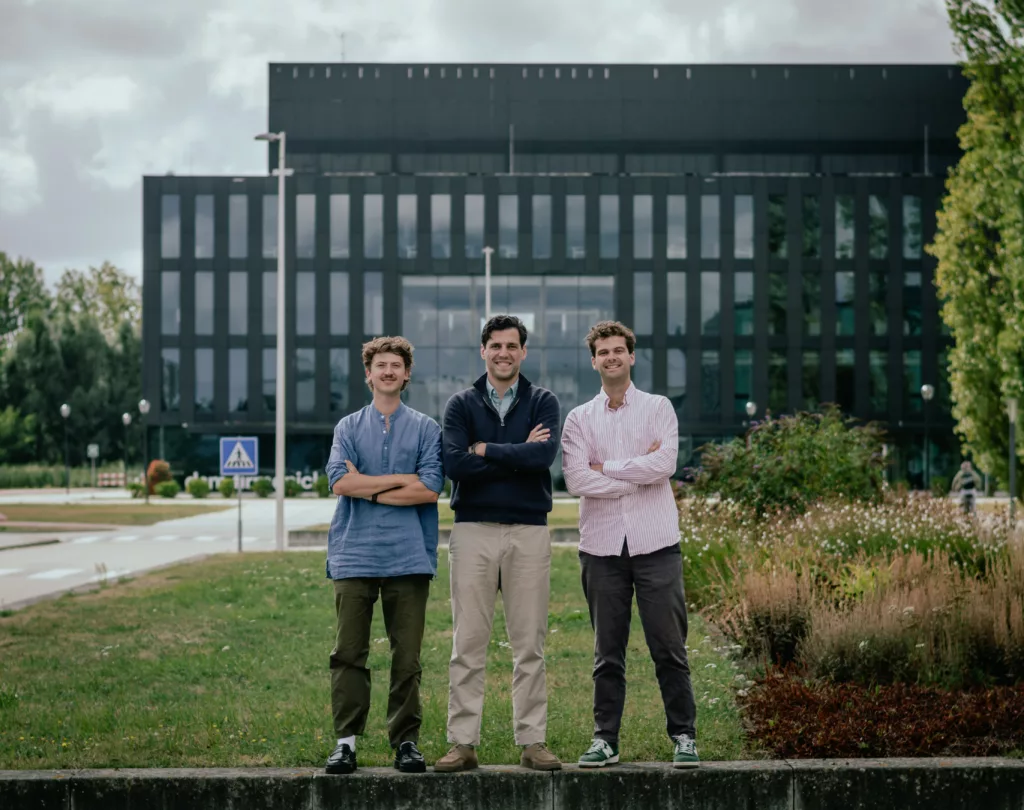
And he is not doing it alone. Haplotagging was co-invented by Frank and molecular biologist Marek Kučka, who leads the laboratory and the bead chemistry as Chief Technology Officer. This year the team welcomed Vikki Yeoman as Chief Executive Officer. She left senior roles in investment and agri-food to build the company commercially. They are supported by bioinformatician Neke Ibeh and by Thijs Wegman on the bench.
It is a small, internationally connected team, working across Groningen and a laboratory at BioCampus Cologne. Much like the food industry they work with, their network does not fit neatly inside one country.
A healthy appetite for risk
For Frank, Biotech Booster has been part of that journey.
“I have been extremely happy with the platform, the support and the network,” he says. Workshops, events and the Business Developers helped the team sharpen its ideas and accelerate its business development. A year and a half ago, Frank says, they understood much less about what it would take to get the technology out of academia. Now they feel far better equipped.
Getting deep tech out of the lab and into the world is hard, and Frank is blunt about what it asks of the people who fund it. The easy instinct is to wait until a technology looks safe, until someone else has proven it or a fund has already written the check. Real support means backing it before that.
“Supporting deep tech is hard,” Frank says. “You have to take the risk early, before anyone else will. That is the whole point.”
So you tag the luggage and send it on its way, trusting that years from now it arrives where you hoped.
Preferably on a plate.