
Biotech Booster connects Business Developers and the newly introduced Impact Developers to the broader ecosystem. While both roles focus on transforming knowledge into impact, they operate in different contexts. Since the role of the Impact Developer was recently introduced at Universities of Applied Science, we plan to feature monthly interviews with Impact Developers in our program.
If you have an idea at a UAS or are an industry partner seeking applied R&D, connect with the innovators featured in this series and explore opportunities to collaborate.
Who are you, and what does your role look like in practice?
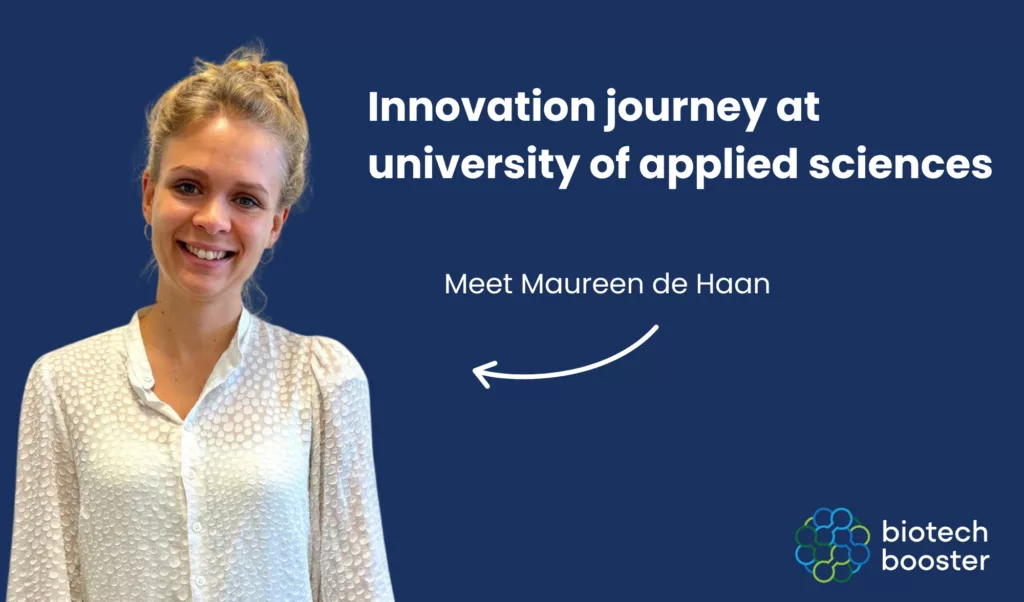
I’m Maureen de Haan, and I’ve been an Impact Developer since September 2025.
I represent the 4 Green Universities of Applied Sciences (CoEGroen), a partnership between Aeres University of Applied Sciences, Van Hall Larenstein University of Applied Sciences, and Inholland University of Applied Sciences. Together, we work to advance green education and innovation.
In my role, I help find, develop, and support early-stage biotech project ideas. A big part of that is figuring out how research can be turned into something that creates value for society. My main focus is on the Agri & Food sector, where there are plenty of interesting challenges to work on.
What inspires or drives you most about working at a University of Applied Sciences?
What I really like is the strong connection with practice. Research is often driven by concrete needs from the market or from society, and working with industry partners is an important part of that.
There’s a lot of focus on asking: what does this research mean and how can we make it useful? I find that combination of research, collaboration, and application very motivating.
Can you share a project or moment that really stayed with you?
The HAS Food Experience 2026 is a great example of student entrepreneurship.
I like seeing how students take an idea and start figuring out what they can do with it. They turn ideas into products and concepts, test them, and think about how they can contribute to change in the food sector. It’s a nice illustration of how much can happen when you give people the space to experiment.
What is something people often misunderstand about your work?
I think valorization is sometimes still seen as mainly about creating a spin-off or starting a new company. But there are many more ways to bring an innovation into society.
For example, an existing company or institution can take an innovation further. That can sometimes mean less risk and a faster route towards implementation and adoption.
In Agri & Food, we also see researchers working closely with end users, such as farmers and food producers. That close connection is really valuable. You can develop the technology and the business case alongside each other, step by step, while continuously checking whether it fits the needs of the people who will use it.
Where do you see the biggest opportunity for UAS in the coming years?
I think there is a big opportunity to strengthen the connection between basic research and practical application. By working more closely with research universities and industry partners, we can connect new insights, applied research, and the needs we see in practice. This can help knowledge move more smoothly towards solutions that create value for society and the economy.
Biotech Booster is a good example of how this can work. By connecting people across the innovation chain and supporting early-stage ideas, it helps create links between research and the next steps towards application.
What would you say to someone considering working with a UAS?
Just give it a try!
Learning by doing is really part of our DNA. We test ideas in practice, learn from the experience, adjust, and try again. You don’t have to have everything figured out from the start. Sometimes you learn the most by simply taking the first step.