
Biotech Booster connects Business Developers and the newly introduced Impact Developers to the broader ecosystem. While both roles focus on transforming knowledge into impact, they operate in different contexts. Since the Impact Developer role was recently introduced at Universities of Applied Sciences, we plan to feature monthly interviews with Impact Developers in our program.
If you have an idea at a UAS or are an industry partner looking for applied research and development, reach out to the innovators in this series to explore ways to work together.
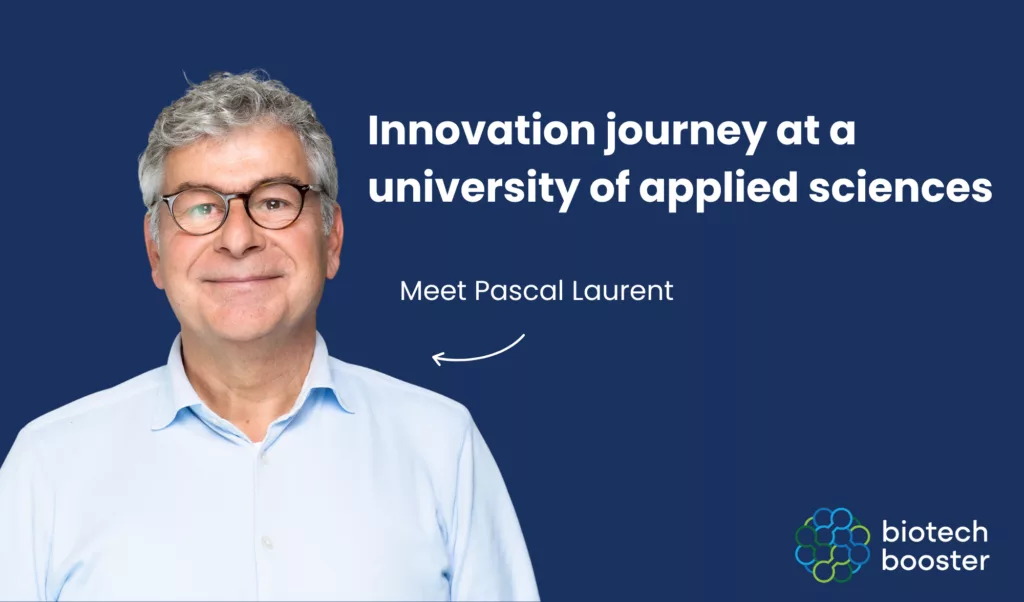
In this interview, we sat down with Pascal Laurent, Impact Developer at the Utrecht University of Applied Sciences.
Q: What makes innovation at a UAS different from other knowledge institutions?
Without the support of a Knowledge Transfer Office (KTO), you must actively build your own network and seek out opportunities for collaboration. Over the past two years with Biotech Booster and at Utrecht University of Applied Sciences, I have built a strong network by attending events and meetings and connecting with people across the ecosystem. At a recent Life Sciences Utrecht meeting, I saw how much support is available. Now, compared to two years ago, I feel much more connected and part of the innovation community.
I want to help people who want to start a company. My work goes beyond biotechnology and includes helping research make an impact and reach people outside of academia. So, if you’re at Utrecht University of Applied Sciences and have an innovative idea, come find me at the Innovation Lab!
Q: Can you share a project or moment that really stayed with you?
Recently, a research group at a University of Applied Sciences created a new way to measure toxicity. This caught attention quickly, and several companies have already contacted us to see how it could help with their challenges.
I am now working to establish partnerships with these companies to bring the technology to market and explore licensing opportunities. We are engaged in discussions about its applications, intellectual property, and partnership models. Most importantly, this discovery is progressing toward implementation.
This is what makes our work exciting and motivating: enabling discoveries to move beyond the lab and create meaningful impact.
Q: What is something people often misunderstand about your work?
Some assume our work is less research-focused because it is applied, but it requires a different kind of rigor. We address complex situations in which solutions must operate within realistic constraints. Our process is hands-on, involving research, design, and practical implementation.
Q: What originally drew you to this type of work?
The enthusiasm of others drew me to this work. I enjoy engaging with optimistic individuals who believe they are on the verge of the next big breakthrough. These conversations are inspiring and make the job rewarding. At times, it is important to ground these ideas by asking critical questions, but the creativity and ambition people bring are truly remarkable.
Q: How does a typical good collaboration usually look between a UAS and a partner outside?
We collaborate with companies that rely on our expertise, offering specialized skills they may not possess. Currently, I am working with three companies. The lectorate has developed a unique method for culturing organoids, which two companies are applying in agricultural and human contexts. A third company is interested in acquiring this model, and we are preparing to negotiate a collaboration or licensing agreement.
Q: What trends or developments excite you most from innovations coming from the UAS?
The lectorate I work with is collaborating with an oral hygiene company to develop a product that delivers antimicrobial agents for the treatment of dental disease. They are also exploring whether fermentation gases, typically considered waste, can be used as an energy source. This project excites me because it transforms waste into a valuable resource, creating a circular process. I appreciate how tangible these projects are, starting with a small prototype and potentially scaling into significant innovations.
Q: Where do you think UAS can make the biggest differences in the biotech field?
UAS focus on understanding how systems function and how they can be integrated. For example, they consider how residential blocks can be designed to improve daily life for families and neighbors. Their approach is highly practical, involving collaboration with communities to address and improve situations, often starting with everyday challenges.
Q: What makes a project a good fit for BB support?
Beyond being biotech-focused and impactful, it is important to consider the project team’s motivation and drive. Assess whether the team demonstrates entrepreneurial initiative and the capacity to advance the project.
Q: If you had unlimited resources for one project, what would this project be?
I would choose a project aimed at eradicating a disease, regardless of which one, without financial limitations. For example, developing a cure for cancer would be extraordinary. Achieving complete eradication of a disease through science or knowledge would be a remarkable accomplishment.