Project

BiloMedics

Cholestatic liver diseases (CLDs), result in severe impairment of liver function and ultimately in liver failure. Patients with these diseases suffer from severe persistent itch and failure to thrive (in young children), and may develop hepatocellular carcinoma.

Due to the lack of long-term effective pharmacological treatment options, liver transplantation is often necessary for survival. Unfortunately, suitable donor livers are scarce, and liver transplantation and post-transplant care are very costly and burdensome for the patient. Additionally, the life-long immunosuppressive treatment following transplantation profoundly reduces quality of life.

CLDs can have widely varying causes of disease, but the common denominator of all CLDs is hepatic and systemic accumulation of bile acids, which become toxic at these high concentrations because of their lipid-dissolving properties. The team of investigators driving this project aims to reduce the development of liver damage in patients with CLDs of various etiologies, thereby alleviating symptoms (including itch, growth retardation) and preventing or delaying the need for liver transplantation which now often has to be performed already in childhood. The approach that will be developed in this Biotech Booster project encompasses modulation of pathways in hepatic bile acid metabolism that so far have not been exploited for this purpose. Preclinical work has demonstrated the efficacy of this approach in various CLD models.

Project team

Jan Freark de Boer, Folkert Kuipers, Henkjan Verkade

Project Number

BIOB24058

Year granted

2024

Status

Ongoing

Applicant

Groningen University Medical Center

Funding

€ 200.000

Sector/Industry

Health & Pharma

SDG's

Good health and well-being (SDG 3)

Thematic Cluster

TC3: ATMPs, Biopharmaceuticals & Associated Enabling Technologies

Level

Level 1
Molecuul

2024

Year granted

Groningen University Medical Center

Applicant

€ 200.000

Project funded
Project story

Plant Beams: breaking through the plant barrier

The question that started Plant Beams For over ten years, David Fernández Rivas has worked on a technology that uses

Plant Beams: breaking through the plant barrier
Project story

SideroFORCE: Tricking bacteria to heal infection

We interviewed Wim Velema, projectleader of Biotech Booster project SideroFORCE, which joined our program in 2025. At sixteen, Wim liked

SideroFORCE: Tricking bacteria to heal infection
IBB

Behind the Bootcamp: Meet the IBB26 Coaches

Building an industrial biotech venture takes more than a great scientific idea. It requires the ability to challenge assumptions, make

Behind the Bootcamp: Meet the IBB26 Coaches
Project story

From Luggage Tags to Better Food

From fragmented DNA to better food on our plates. We interviewed Biotech Booster project Haplotagging to learn more about their

From Luggage Tags to Better Food
Impact developer portrait

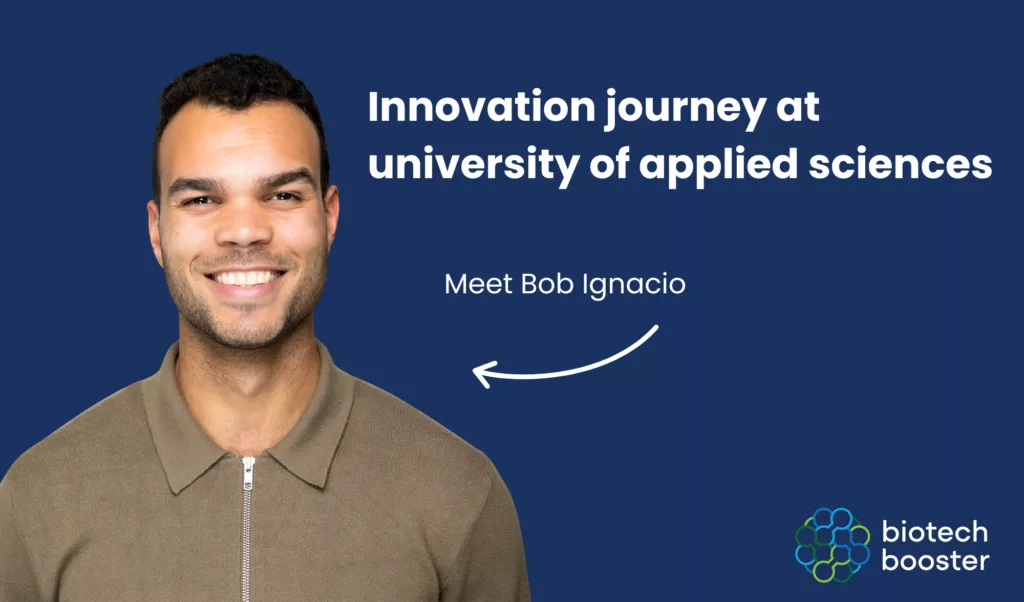
The Innovation Journey at the Universities of Applied Sciences

Impact Developers help researchers turn their ideas into innovations that impact society. They connect researchers with companies and other partners

The Innovation Journey at the Universities of Applied Sciences
Alumni Column

Alumni column: Patrick Dekker from iProtics

On both sides of the table. Some people know Biotech Booster from the outside. Others experience it from the inside,

Alumni column: Patrick Dekker from iProtics
Citaat

Biotech Booster helps us through funding and by providing us with a network to validate where we can make the best impact with our new analysis device.

Biotechnology netherlands

Carlos de Lannoy

Constellate

Citaat

What we look forward to most is leveraging the extraordinary network of Biotech Booster that we need to get foot in the market, get know-how, and understanding the competitive field which is necessary for setting up successful operations.

Biotechnology netherlands

Pim Schaasberg & Martin Pabst

ProteoT

Moleculen

Newsletter

Receive monthly updates about our community!

Subscribe to our newsletter