
Food security and climate change are reshaping the future of agriculture. As farmland becomes scarcer and weather conditions more unpredictable, plant breeders face growing pressure to develop crops that are more resilient, productive and adaptable.
Biotech Booster project Haplotagging is working on a technology designed to support exactly that challenge.
Built around a versatile DNA sequencing method with applications across multiple fields, the Haplotagging project team, led by Prof. dr. Frank Chan and his co-inventor, Dr. Marek Kucka, have sharpened their focus toward smart breeding technologies for agriculture, helping breeders identify promising crop traits faster, more accurately and at lower cost.
Along the way, the project also became an example of something else: how collaboration across institutions and disciplines can help emerging technologies find direction and momentum.
A sequencing technology with broad potential
At the core of the project is a DNA sequencing method built around microbeads. The technology simplifies complex lab workflows into a single reagent while preserving the crucial DNA haplotype structure during sequencing.
That additional layer of information helps researchers better understand genetic variation and improves the accuracy of sequencing results.
Most important, the haplotype carries crucial information on trait values that breeders have wanted to select for – but that was thus far inaccessible. For the first time, haplotagging makes this information tangible – not only for large multinational breeders, but also for smaller companies and for crops that currently receive less commercial attention.
The potential applications were broad from the beginning.
“When the project first came in, the technology could theoretically fit several different application areas,” says Jasper Dijkstra, business developer at University of Groningen, who was one of the first people involved with the project through Biotech Booster.
The team initially explored multiple directions, including applications in human diagnostics. But during early conversations, another opportunity began to stand out.
Finding the right application
One of the key early discussions revolved around focus. Though the project started with a broad interest in applying a sequencing technology and exploring where it could deliver the most value, early conversations led to a focus on agriculture and crop development: particularly genotyping and breeding crops that are more resistant to drought and climate stress. The project applied for Biotech Booster’s Agriculture & Food cluster and started developing around one concrete use case and market.
“That focus created depth,” Jasper says. “Instead of trying to address everything at once, the team could develop a specific business case, identify potential customers and build expertise around a real problem in the market. It also meant that the team’s guidance logically transitioned from me to my Biotech Booster colleagues at other knowledge institutes, who bring the right relevant and targeted domain expertise and network.”
Expertise from different corners of the ecosystem
Although Haplotagging originated from the University of Groningen, the project was guided by Biotech Booster business developers from other institutions through the Biotech Booster programme. Lisanne Hameleers from Vrije Universiteit Amsterdam and Nikita Sajeev from Wageningen University & Research proved to have the most relevant domain expertise and network that would help the project move forward. Together, they helped connect the team to relevant agro-food networks, industry contacts and sector-specific knowledge.
According to them, the collaboration quickly became less about institutional boundaries and more about shared momentum around the project itself.
“You stop noticing where people are based,” they say. “The focus becomes: what does this project need, and who can most effectively contribute to it?”
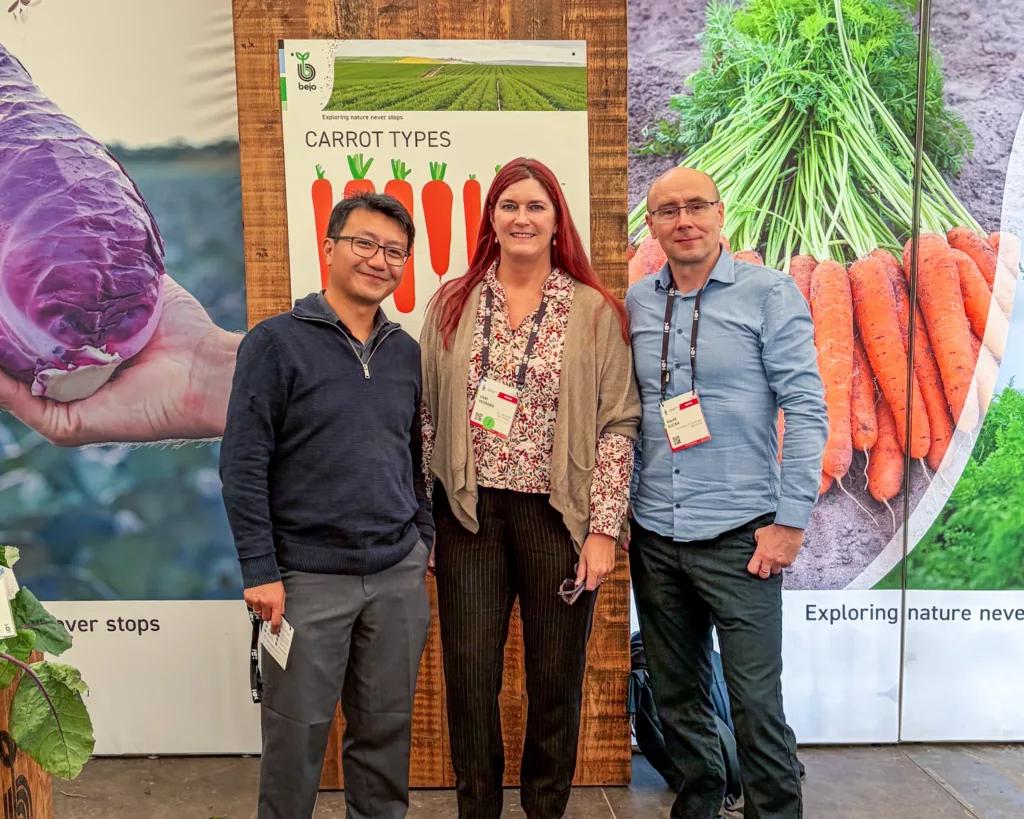
That included support ranging from strategic positioning and investor introductions to visibility within the agro-food ecosystem, including presentations at industry events such as CropIB.
Lisanne explains: “Project guidance becomes much stronger when you combine different types of expertise, no matter where people are based. The way Biotech Booster is structured, as a national network connecting knowledge institutes, allows for people to collaborate across knowledge institutes and bring in the right expertise around a project. It really stops mattering which institution someone works for – the focus shifts entirely to what the project needs to move forward.”
Nikita agrees and adds: “You quickly stop thinking in terms of institutions. The focus becomes: what does this project need to move forward? Everyone contributed from their own expertise, networks and ecosystems and that created a very natural way of working together.”
Lowering barriers for smart breeding
The long-term ambition behind Haplotagging is to make advanced breeding technologies more accessible and scalable.
Today, many smart breeding approaches remain expensive and technically complex, limiting their use to major breeding companies and a relatively small number of crops.
By reducing sequencing costs and simplifying workflows, Haplotagging aims to broaden access to these technologies – potentially helping breeders develop new crop varieties faster while preserving genetic diversity and adapting to climate-related challenges.
The project team is currently working with breeding partners to explore applications in breeding, genome profiling and variety development, while simultaneously building the commercial foundation for future scaling.
The Haplotagging team says: “The technology was designed to work across species, including human genomics. Through Biotech Booster, we gained access to agro-food networks and industry expertise that complemented our existing scientific connections. This has greatly sharpened our focus and jump-started many conversations. Crucially, the many workshops, pitch events and the opportunity to showcase our work at CropIB helped us build commercial relationships in the seed industry faster than we could have done alone. We can’t be happier with the results. We are extremely grateful to Biotech Booster. Their team and their network deserves a lot of the credit for our project’s success.”
Cross-institutional collaboration as part of the valorisation process
For everyone involved, one of the interesting aspects of the project has been seeing how naturally the collaboration developed between people from different institutions and backgrounds.
Rather than each university or research institute operating in isolation, Biotech Booster creates a national framework in which expertise can move toward the project where it is most needed.
For the Haplotagging team, that meant transforming a promising technology into a focused business proposition supported by a distributed network of experts.
And for Biotech Booster, it offers a concrete example of what its collaborative model can achieve in practice.